
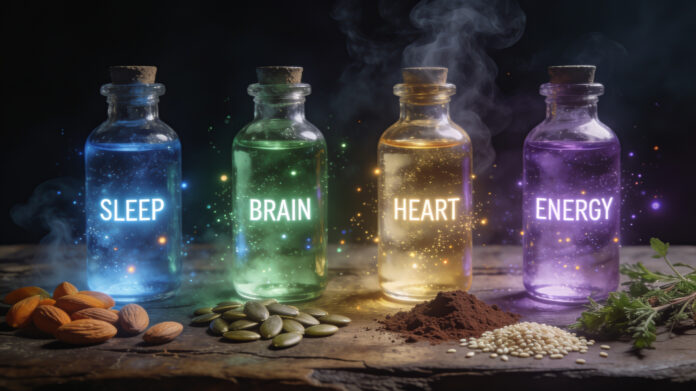
Most people know they need magnesium. Almost nobody knows which kind — and that’s exactly why it’s not working for them.
First — How Much Do You Actually Need?
- Men 50+: 420mg daily
- Women 50+: 320mg daily
The upper safe limit for supplements is 350mg per day. Above that, digestive problems kick in. Food sources have no upper limit — your body self-regulates.
Can the Home Blend Cover Your Daily Needs?
Here’s the honest answer.
The Natural Magnesium Blend:
- 4 tbsp Roasted Pumpkin Seeds = 128mg
- 2 tbsp Sesame Seeds = 60mg
- 1 tbsp Almonds = 27mg
- 2 tbsp Cocoa Powder = 30mg
- Total: ~245mg / ~290 calories
Spread across the day as 2 tbsp per serving (3 servings):
- ☕ 2 tbsp in morning coffee
- 🥣 2 tbsp in yogurt at lunch
- 🥛 2 tbsp in warm milk before bed
This covers ~60-75% of your daily needs — naturally, no pills, no side effects.
The remaining 25-40% comes from your regular food — spinach, avocado, banana, dark chocolate.
Can it replace a supplement? For mild deficiency — yes. For serious deficiency — use it alongside the right supplement below.
The 4 Types — What They Are and What They Actually Do
😴 1. For Sleep — Magnesium Glycinate
What it is: Magnesium bonded to glycine, an amino acid that calms the nervous system.
Why it works for sleep: Adults with poor sleep quality who took 250mg of magnesium bisglycinate daily for four weeks showed significant reduction in insomnia severity compared to placebo.
Dosage: 200-350mg elemental magnesium, taken 1-2 hours before bed. Results typically appear within 2-4 weeks.
Can you make it naturally? Magnesium glycinate doesn’t exist in food. But your body can create its own version if you eat magnesium-rich foods alongside glycine-rich protein foods.
Natural Sleep Tonic — take 1-2 hours before bed:
4 oz / 120ml tart cherry juice (natural melatonin source)
2 tbsp of the Magnesium Blend powder
Warm water to fill the glass
1 tsp raw honey
Stir and drink slowly.
If you need a supplement: Look for Magnesium Glycinate or Bisglycinate. Avoid Magnesium Oxide — only about 4% of magnesium oxide is actually absorbed.
🧠 2. For Stress & Anxiety — Magnesium L-Threonate
What it is: The only form of magnesium that crosses the blood-brain barrier directly.
Why it works: A 2026 clinical trial found that supplementing with magnesium L-threonate for six weeks was associated with significant improvements in cognitive performance, working memory, and an estimated 7.5-year reduction in cognitive age. Biology Insights
Dosage: 2,000mg of magnesium L-threonate daily (which delivers approximately 144mg elemental magnesium). Take in the morning or split morning/afternoon — not before bed as it can be stimulating for some people.
Can you make it naturally? No. Magnesium L-threonate is formed from mixing magnesium and threonic acid, derived from the metabolic breakdown of vitamin C. This specific form cannot be replicated through food alone.
What you CAN do naturally: Eat magnesium-rich foods alongside Vitamin C sources — citrus, bell peppers, strawberries. Your body produces threonic acid from Vitamin C metabolism.
If you need a supplement: This is one form where a supplement is genuinely worth it if brain fog, anxiety, or memory are your main concerns.
❤️ 3. For Heart & Blood Pressure — Magnesium Taurate
What it is: Magnesium bonded to taurine, an amino acid that supports heart function.
Why it works: A large meta-analysis of randomized controlled trials published in 2025 found that oral magnesium supplementation significantly reduced both systolic and diastolic blood pressure compared with placebo.
Dosage: 100-300mg elemental magnesium daily, taken with food. Consistent daily use is key — results build over 4-8 weeks.
Can you make it naturally?
Taurine is found in: fish, meat, eggs, dairy. Magnesium is in: pumpkin seeds, spinach, dark chocolate.
Natural Heart Tonic — daily with lunch:
2 tbsp Magnesium Blend in plain yogurt
+ one serving of fatty fish (salmon, sardines, mackerel)
or 2 eggs
The combination of magnesium from the blend + taurine from the protein = your body gets the building blocks of Magnesium Taurate naturally.
If you need a supplement: Magnesium Taurate is the specific form to look for if blood pressure is your primary concern.
⚡ 4. For Energy & Muscle Pain — Magnesium Malate
What it is: Magnesium bonded to malic acid, which plays a direct role in cellular energy production (the Krebs cycle).
Why it works: Malic acid is the compound that makes apples tart. It’s a key player in how your cells produce ATP — your body’s energy currency. Without enough malic acid, energy production slows. Muscles ache. Fatigue sets in.
Dosage: 300-400mg elemental magnesium daily, ideally taken in the morning with food. Unlike glycinate, this one works better during the day — not before bed.
Can you make it naturally?
Malic acid is found naturally in: green apples, tart cherries, grapes, pears.
Natural Energy Blend — take in the morning:
2 tbsp Magnesium Blend
Blended into a smoothie with:
1 green apple (malic acid)
1 banana (natural magnesium + potassium)
1 cup spinach (additional magnesium)
1 cup water or almond milk
Total magnesium from this smoothie alone: ~120-150mg
If you need a supplement: Magnesium Malate is the form to look for — particularly if chronic fatigue or fibromyalgia-type muscle pain is the issue.
The Honest Bottom Line
| Type | Best For | Can You Make It? | Daily Dose |
|---|---|---|---|
| Glycinate | Sleep, anxiety | Partially — tonic works | 200-350mg |
| L-Threonate | Brain, memory, stress | No — supplement needed | 2000mg compound |
| Taurate | Heart, blood pressure | Partially — food combo works | 100-300mg |
| Malate | Energy, muscle pain | Yes — smoothie works | 300-400mg |
The home blend covers the foundation for all four. For serious, targeted issues — pair it with the specific supplement form.
Start with the blend. Give it 30 days. Then decide if you need more.
For educational purposes only. Always consult your doctor before making changes to your health routine, especially if you take medications.